Inspiration is a Time Not a Thing

ScannedImageInspiration, it does come from where you think and often comes to you when you least expect it. I had an acquaintance tell me that I was an inspiration the other day. I accepted it as a compliment, but I have to admit it really got me thinking.  What makes an inspiration? Where does inspiration come from? Do I take it for granted at times?

The context of the compliment I received was in discussing what I do for a living, I am a freelance crochet designer. But I haven’t always been. Much of my life has been in public service; assisting caregivers and older adults in locating resources to help stay at home and meet their wishes for aging gracefully. (If you are needing assistance please contact your local Area Agency on Aging office, they cover the entire US, and are amazing almost hidden gems) But things changed at my local government office and circumstances changed in my life, there was no longer a match that was positive for both of us, so the little design hobby that I began a year earlier was now my full time passion.

When explaining this story, probably with a little more gusto and some extra details that don’t really add to the basic premise, I had inspired this acquaintance. When I asked how, they told me because I had the courage to step out of what I had already known and believed in myself. That is a powerful statement.

I never really thought of my life in that manner before, believing in myself and taking a risk, it was just the option available to me at the time. But I guess in a sense they are right. In the last 2 years that I have been doing this work, it has changed how I look at things, but that is a discussion for another day.

Usually when I think of inspiration it is something “out there” somewhere in the universe, but really we are all inspirations to each other. The simple decisions, which each of us makes, reflect to others and encourage them to find more in themselves.  Our growth is unseen to us, but noticed by others, making a difference that we cannot even recognize.  It is kind of like kids growing over summer, they haven’t realized that they grew an extra two inches in three months, the parents may not have directly noticed it either, but when they put the school close back on of the first day, or grandma comes to visit, you find the pants that are well above the ankles and that grandma is not bending down to give hugs; growth has happened.MP900070786

So I guess inspiration is that point in time when you see or hear something that you really need to, in order to help point you in a new direction, and open up possibilities in your mind of where you want life to take you. Inspiration isn’t a thing, it’s a time. Even artistically this can apply, one day a sunset can inspire a new stitch pattern or color way for a design, other days it is just a sunset.


A Positive to Social Media?

ScannedImageOkay so this is a little different topic for me than usual, but I was doing some internal reflection and realized that social media has changed me. Sure information is at your finger tips (the reliability of that information should always be questioned, but that is a different matter), communication is seemingly easier than ever. But why is it then that I do not actually speak to old friends as often? I think this question has been bridged by most people at some time, but that is not the change I found most in myself.

The change I noticed is that I am actually somewhat nicer. For people that have met me in person, they realize that I have a quick wit and play on words (okay, most would call it being a smarty pants or other phrases that have other meanings as a donkey). But using social media, I know that 1 statement can be taken 6 different ways by 5 of my friends, so I tone it back and actually think of my words before I type them. (Really I do, although if there was a sarcasm font, I would probably find this quite helpful).Wireless Computer Mouse

So is this really causing a change? Or is this just being politically correct? Well I think it has actually been a change for me. Causing me to actually think about what I say before I say it (this does not always occur in person, but it is actually much more toned back in general, but get me around old influences and there is no promises of anything).

MP900405386Making this reflection about myself, caused me to realize there are at least three different types of people on social media, those that say nothing but watch what is going on around them, those that say whatever is on their mind regardless of how it might be taken (some I actually think are attempting to upset people) and those that might be thinking of their words. Granted that is generalizing quite a bit, but it has been where my thoughts have taken me.

Some may not feel that there are any redeeming qualities in social media, but I think at least for me, it has helped to put my words in prospective and maybe even taken the edge off them.

Viewing the Tone, Matching Your Yarn to Your Pattern

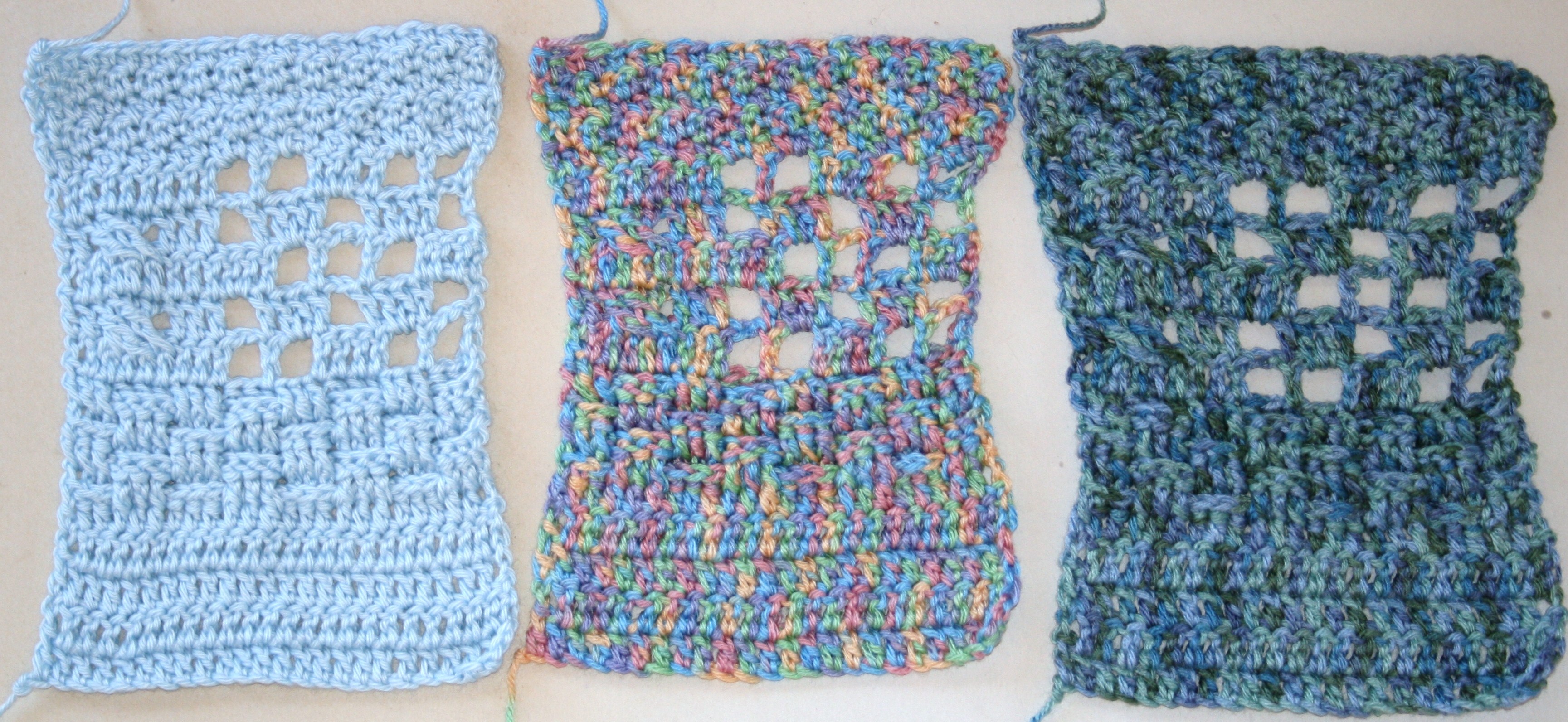
ScannedImageIt has happened to many times; a marriage between a beautiful yarn and a wonderful pattern does end up as spectacular as expected. What could it be? Simply put not all patterns are designed the same. Sometimes you have a pattern that highlights the yarn, other times you have a yarn that highlights a pattern.

IMG_5669

Same stitches, different tones and colors, notice the difference throughout each swatch, can you see the basket weave? Can you see the small cables next to the filet?

This usually comes into play with multi-tonal yarns and textured or lace patterns. The yarn draws so much attention to itself that is can lead the eye away from all the skill and technique you have put into cables, and popcorns, and filet work.  The texture gets washed out and only the color remains.

This doesn’t mean that you cannot use multi-tonal yarns in intricate designs, but it is finding the correct match. Usually multi-tonal yarns need large designs, or large blocks of consistent stitches. By this I mean that they need solid spaces to let the color play do what it wants to, whereas a solid tone yarn can easily highlight more detailed textured stitches, such as posts and filets. Since the tone is consistent the eye is not lead away.

IMG_5669 - Copy

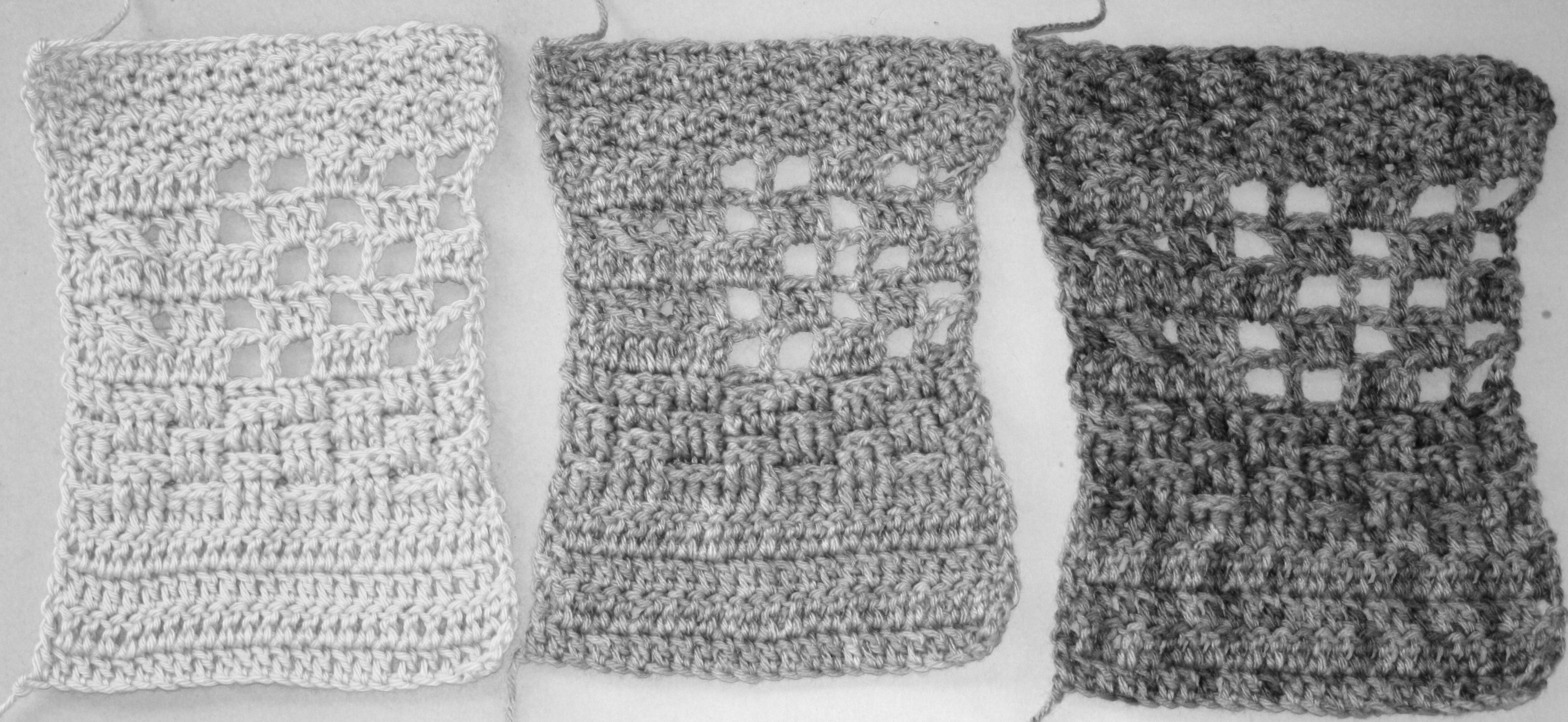
Review the same swatches with out the color and simply see the tone, do you notice a difference?

You are probably wondering why I’m using “tonal” instead of “color”; this is because more of the cause of effect is due to the tone not the color. The tone is what would be represented if the values were represented as black and white photographs. When looking at the tones of a color, green and red have the same value as a medium gray and yarns using these as a multi-tone will not be as eye distracting as a yarn using yellow and red. Since the yellow would generate a brighter value on the gray scale then red, it will draw the eye differently, and catch its attention. Give it a try with yarn in your stash, simply take a picture and convert it to black and white and see which yarn grabs your attention. Is it the same as the yarn when viewed in color?

The colors will also be varied in the grayscale values dependent upon the shade of the color, pastels are brighter then rich jewel tones for example, so that plays into the color play as well. The eye for color and value can be learned, it can be recognized. But it does take a conscience effort to find the match between the texture and the color. Keeping this concept in mind when matching your yarn to a project can really help to give you an end item that is the star of the show!

Where the Crocheters Are

DSCF0492

Guests at CGOA Conference Dinner in Indianapolis 2013

ScannedImageI never really think to pull out my camera, so I’m probably an abnormality in this day and age, which is why I didn’t get more photos of all the wonderful things I saw. Last week I was in Indianapolis last week attending the Crochet Guild of America (CGOA) Summer Chain Link Conference (sometime known as the Knit and Crochet Show), and had a wonderful time. There are always so many inspiring people that have a love for crochet (most of which are not published designers, or national teachers, not that those aren’t inspiring as well).

DSCF0493

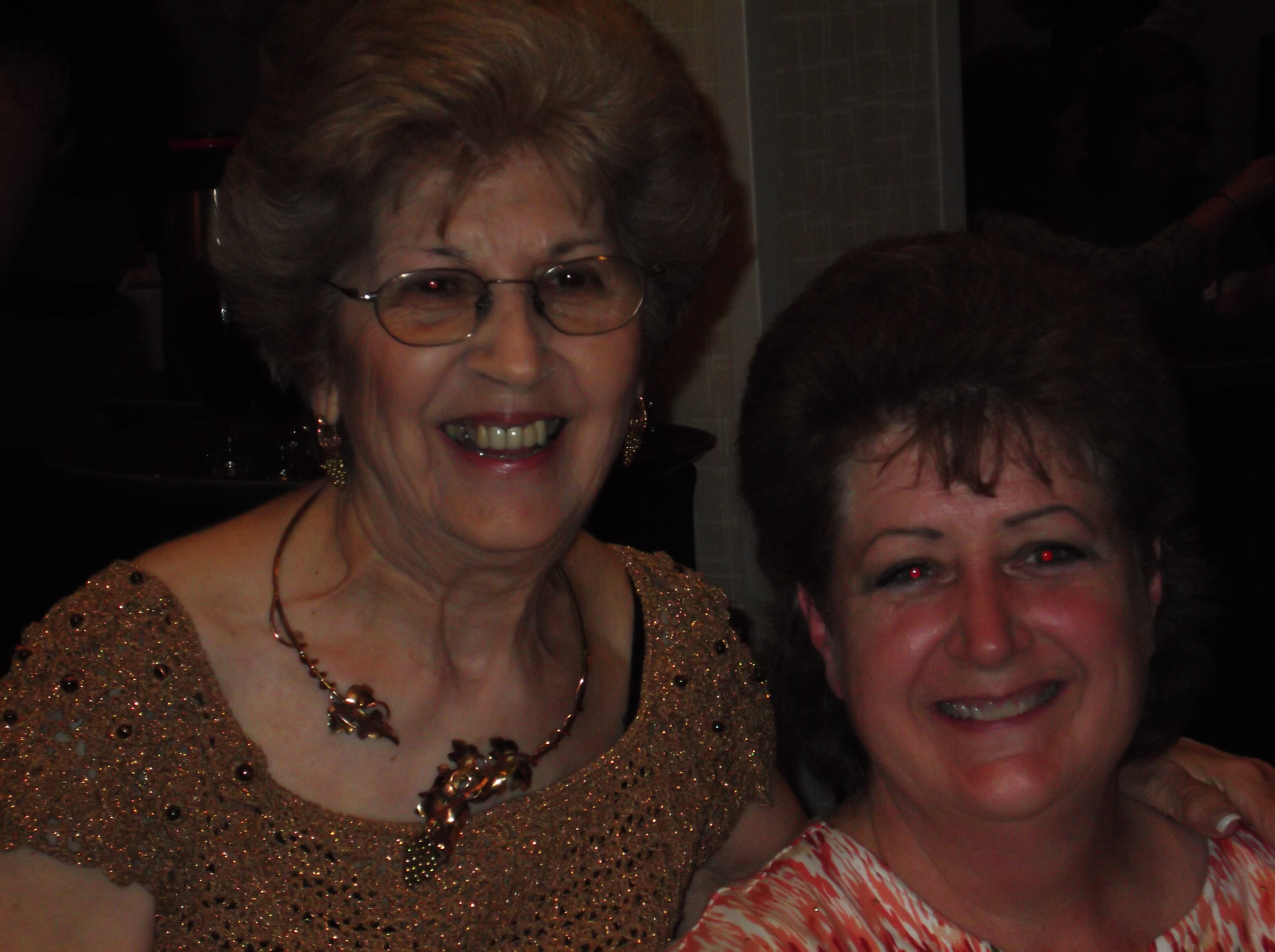
Margaret Hubert and Nancy Smith- 2 great women that inspire crochet

If you have never attended a national conference, I recommend that you at least investigate going someday. If you are like me, you have looked at the cost and asked yourself, “Really, I think I could learn that from a book/video, so why spend that, to go there?” A very valid question, but what you get from the conference cannot really be measured in dollars. Granted attending a conference has launched my crochet career, but even if it hadn’t I would probably still attend, as the camaraderie of fellow crocheters is enough to encourage you to attempt new things and improve your hobby/craft in ways you could never anticipate. There is nothing like walking through a hotel lobby and seeing groups of crocheters seated in various clusters chatting and stitching away. I can’t think of anywhere I’ve felt so at home.

Some are fortunate enough to have this experience in their local community through crochet guilds or stitch clubs, at least at meetings and events that they sponsor. The conference is just a really large version of this, not to mention the teachers have many years of teaching experience and years of expertise, they have forgotten more then I will ever learn.

IMG_20130720_204412

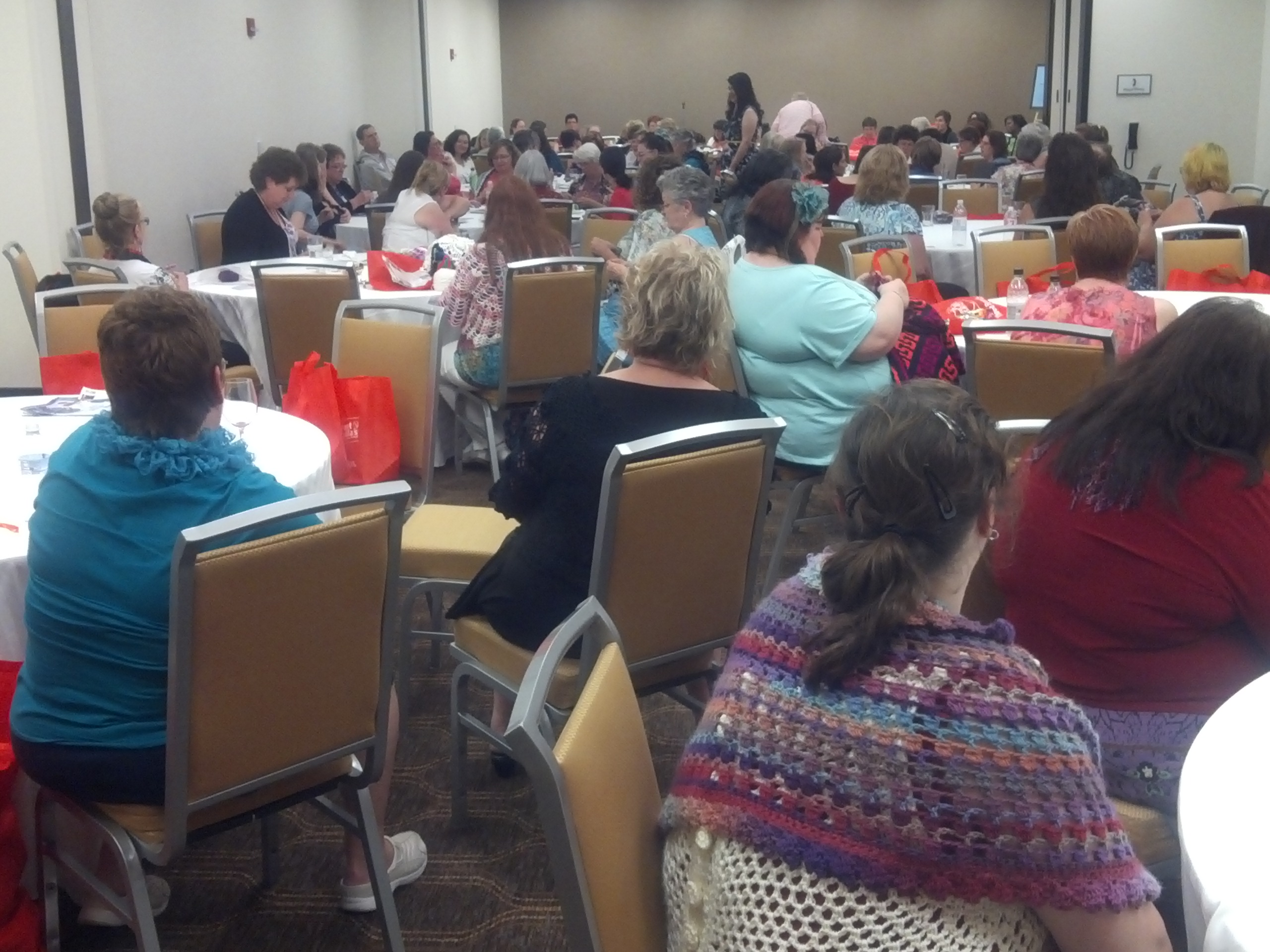
Fun Night at the Conference in Indianapolis 2013, Show & Share

Image 2013-07-23 1

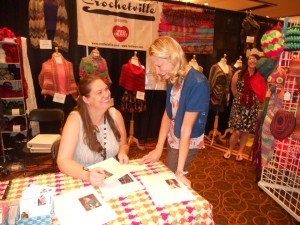
My first pattern signing!! Thanks to Crochetville.com, Amy Shelton, Tammy Hildebrand, and Ellen Gormley for all the support.

Well I could probably go on for a while about how much I love these conferences, but if you are interested in experiencing one for yourself, join me October 2-6 in Concord (just outside Charlotte), NC (click here for more information), or if you would like to create a crochet community in your town, investigate the support the CGOA can provide in helping you.

Appreciate the Thread

ScannedImageWhen most people think of crochet, they think of granny squares or doilies. The same techniques may be used in both, but there is a different skill set for each.  From reviewing most of my crochet work, I usually play with yarn, and thus take it for granted, but picking up some thread can easily bring all the technique needed to crochet into focus for me.

It is not that yarn and thread crochet have that many differences, they use a hook, they have the same stitches and they are creating a series of knots, but where the differences come into play is the execution of those stitches. In yarn I automatically adjust my tension dependent upon the yarn weight and fiber type (some silky yarns tend to slide a bit), but nothing in the yarn realm can prepare me for tensioning thread.

IMG_5628

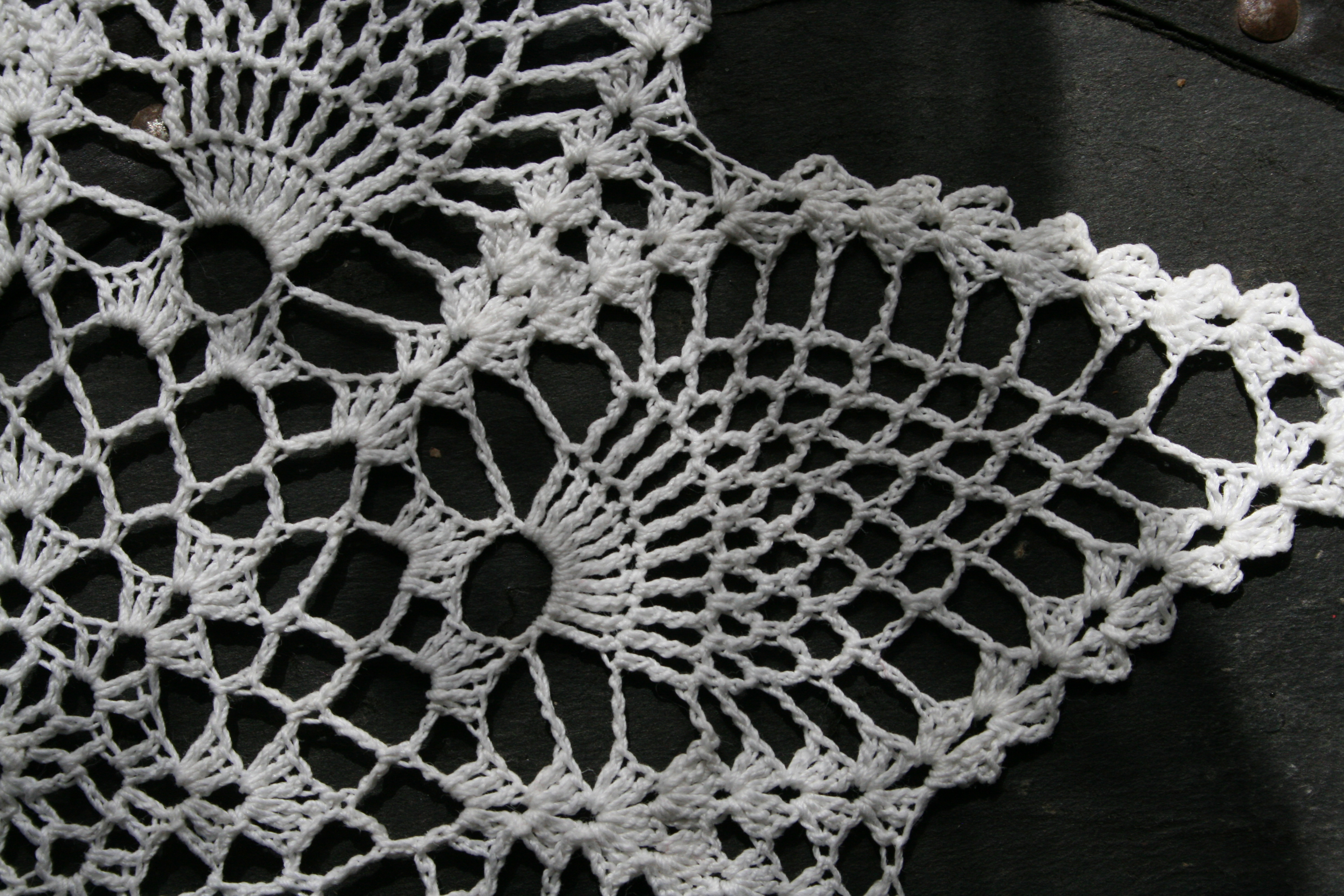
Some beautiful thread work by my friend Phyllis Nabakowski

Tension can definitely affect the appearance of your work, more than first realized. Some tensions are too tight and stitches are tight and compact compared to a tension that is too loose, resulting in stitches that appear sloppy. Too tight/loose tension can make it appear that you are using the incorrect hook size, but it doesn’t really improving after you adjust your hook.

I usually keep a fairly loose tension, thus I pull the yarn out of the skein and then begin to crochet, but with thread this is far too loose for me, and I have to weave it through my fingers differently in order to get control of it. I usually don’t wrap yarn around my fingers but weave it between them, thread I wrap around a finger to increase my tension and thus improve my stitches.

Even adjusting for my tension, there is a factor within thread crochet that varies greatly from yarn. Thread is less forgiving. Often in yarn projects mistakes are masked by the yarn, but in thread every aspect of your work is seen. The direction that you pull up you yarn-overs (YO) is even noticeable in thread crochet, so you have to pay attention to your work. It is a medium that I practice in, so that I can have some presentable thread work.

If you haven’t had success with using thread, play with it and see if adjusting your tension and paying attention to your stitches help, and appreciate the work of those that have mastered these skills. Those small dainty stitches are the work of disciplined techniques.