A free pattern means that it is that time again, the New York Sheep and Wool Festival (a.k.a Rhinebeck)! Just like most everything else this year, it will be done a bit differently…as in virtually (find out information here).
This means that you do not have to live in or travel to Duchess County New York. You can be anywhere in the world and take classes, visit booths, and get a little hint of the New England turning leaves.
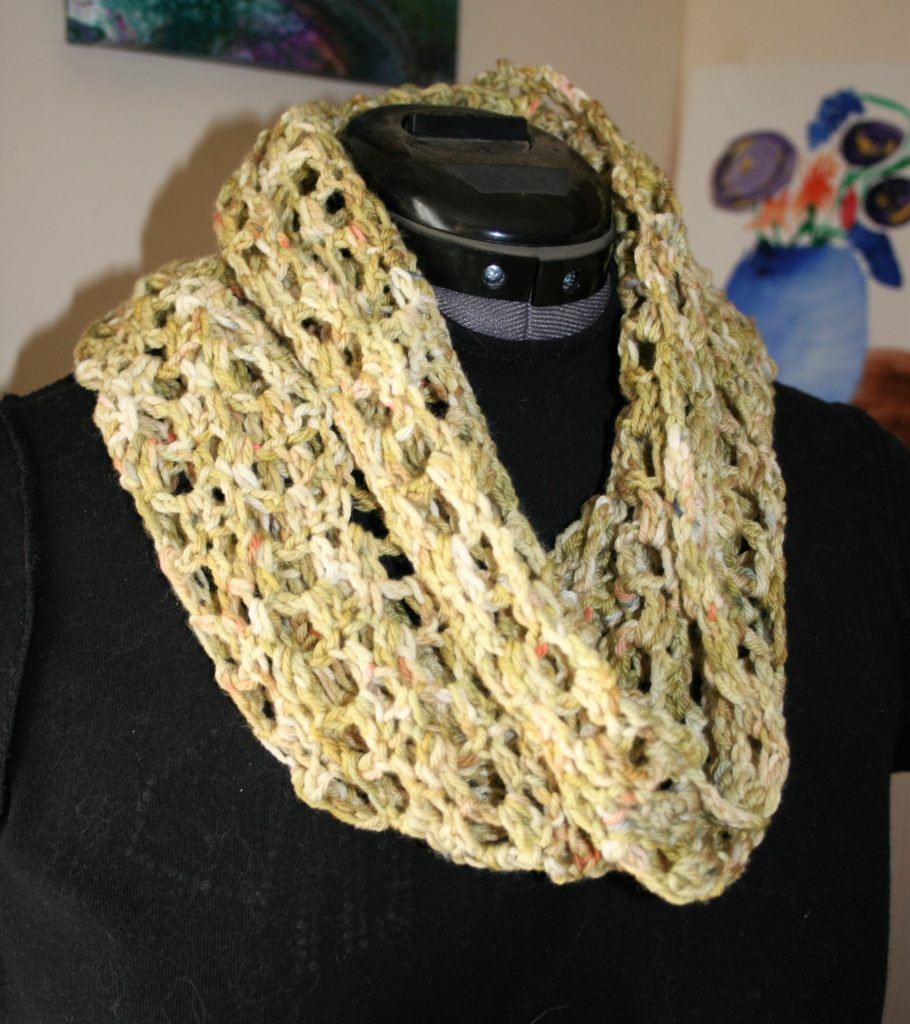
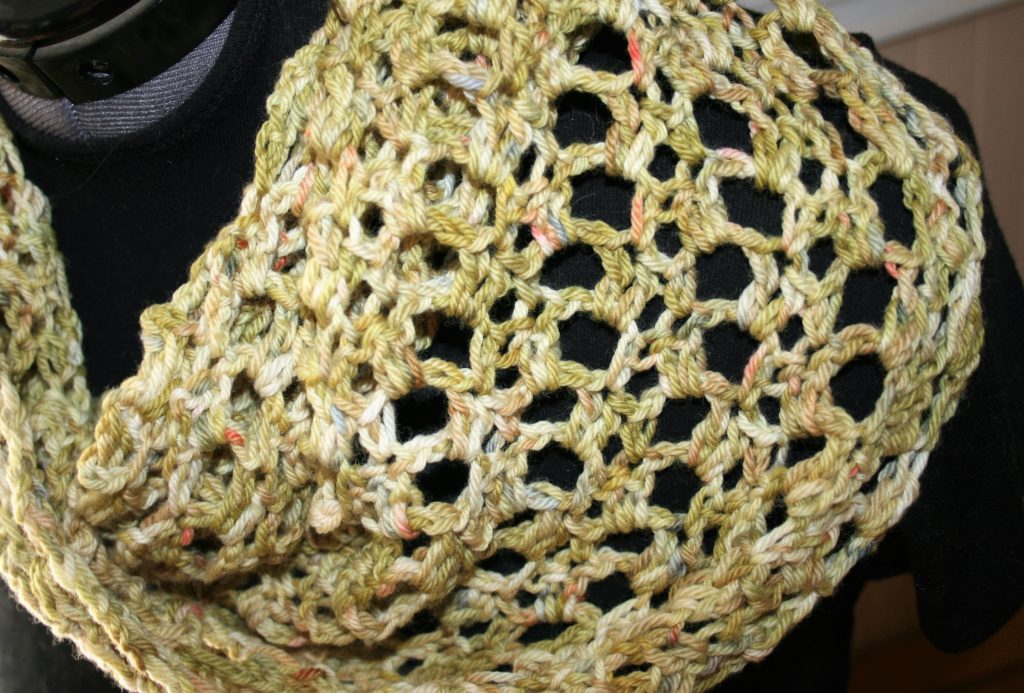
Lisa’s Ladder Cowl
For the last several years I have been teaming up with Lisa Souza Dyeworks and providing a free pattern to accompany her limited addition colorway for the week. This year is no different.
Help me help local communities by creating blocks for Warm Up America, by making a block for yourself and one for a community project with this free pattern. I will be creating a new block every two weeks and sharing it with you, I just ask that make one for donation.
Warm Up America is a nation wide organization that encourages local donations, but will also except donations to be sent to their office so that blocks can be assembled and then blankets can be donated through the United States.
Even if you do not want to participate with Warm Up America, please consider creating blocks, or blankets for your local community. There are various places in every community that accept donations.
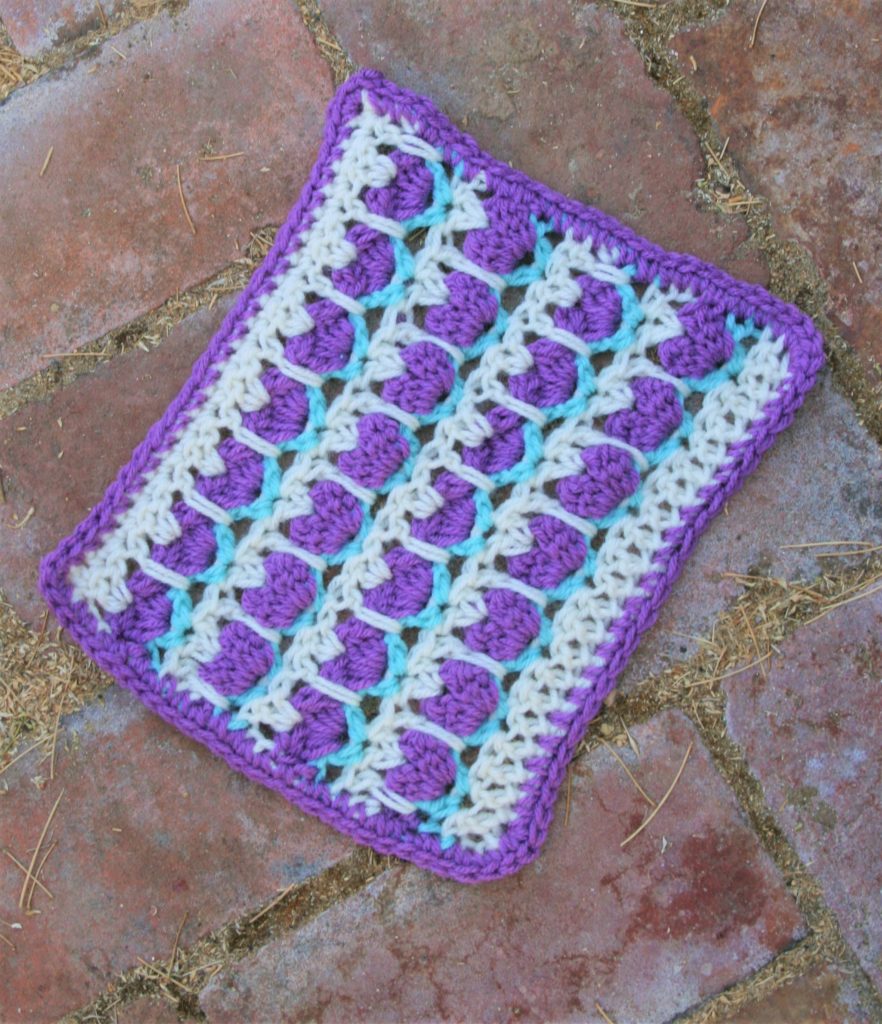
Garden Block
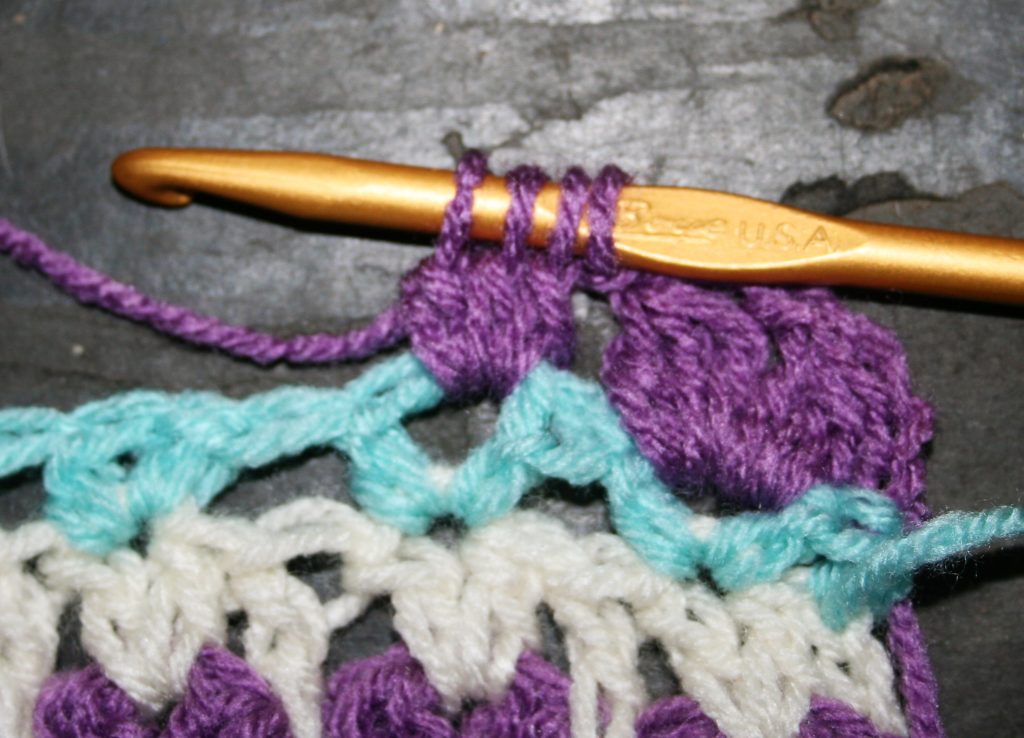
This block features color change, that does not require you to break the yarn. You can carry the yarn up the edge, as the color changes every row, and then finish the sides with edging.
I was inspired to create this block due to my lack of a green thumb. I try, and I think this season will be different. Yet it always ends the same…with a bunch of brown where I was expecting green.
This block lets me enjoy a little row of crocheted flowers.
Flower Bobble (FB): [Yo, insert hook in indicated stitch, yo, pull up a loop, yo pull through 2 loops] 3 times, pull through all 4 loops on hook, ch 1, [Yo, insert hook in indicated stitch, yo, pull up a loop, yo pull through 2 loops] 3 times, pull through all 4 loops on hook.
First half of a Flower Bobble
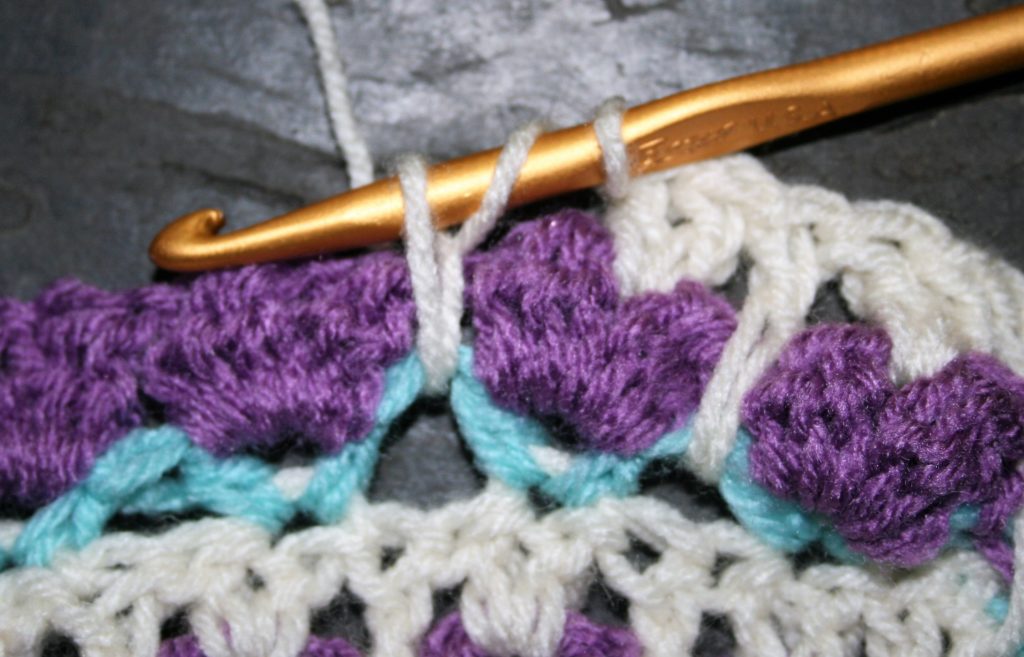
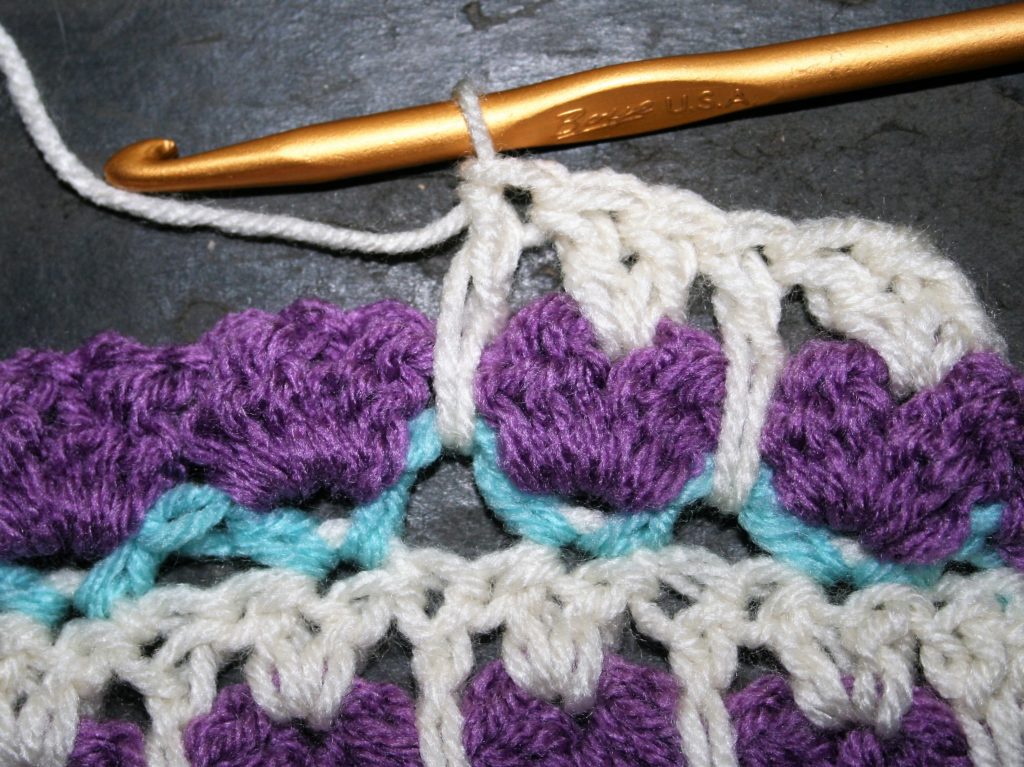
Long Loop Double Crochet (LLdc): Work as a regular double crochet, however the placement if the first Yo and insert hook is worked two rows below working row, Yo, pull loop up to height o working row, and complete double crochet.
Yo, insert hook, pull up a long loopFinish double crochet stitch
Block Pattern
Ch 25
Row 1: With (A), dc in fourth ch from hook, dc in each ch across, change to (B), turn. -23dc
Row 2: Ch 2, sk 1, (hdc, ch 1, hdc) in next st, [sk 2, (hdc, ch 1, hdc) in next st] rep 6 times, sk 1, hdc in last st, change to (C) turn. -7 (hdc, ch 1, hdc)
Row 3: Ch 2, FB in each ch-1 sp across, hdc in last st, change to (A) turn. -7FB
Row 4: Ch 3, [2 dc in ch-1 sp in center of FB, LLdc between hdc stitch 2 rows below] 7 times, dc in last st, change to (B) turn.
Row 5-13: Rep Rows 2-4, do not change color at the end of Row 13.
Row 14: Ch 1, sc in each st across. Fasten off.
Rnd 1: Join with B to any corner, orking around edges of block, sc evenly working 3 sc in each corner. Fasten off. Weave in ends.
It is always interesting to see how different events can present themselves from contact made years earlier. This last week I was approached to help on a Sheep to Shawl team.
What is a Sheep to Shawl?
A Sheep to Shawl is an age old competition that I have seen several times at many Fiber Festivals. Each competition has slightly different rules, but only slightly. Essentially it is a team of people (usually seven) that work in a set time limit. In this time limit they prep a sheep fleece, teasing the wool and carding it. They then spin it into “singles”, then ply these “singles” together to create yarn. The yarn is then woven on a loom to create a shawl of set dimensions by the competition.
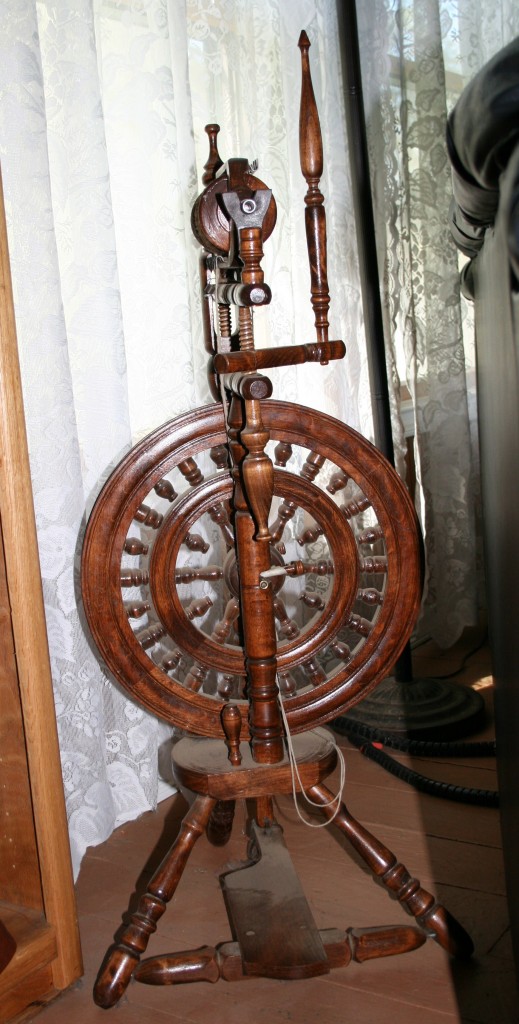
I dusted off my spinning wheel…
This is usually entirely completed in 4 hours.
A Virtual event…
With the current situation of the world most Fiber Festivals have been canceled or re-imagined. The Lambtown Festival in Dixon, California has re-imagined this competition in a virtual setting.
Teams are allowed a total of 28 hours to complete this process, but need to provide all these hours on a Zoom presentation. The 28 hours essentially creates this shawl in the same time setting as in-person, as the hours are counted from every participant.
This means that everyone is working quickly, in their own home setting,. Then figuring out how to get need supplies to the next participants to complete the steps. It is an interesting undertaking.
Where I am Invited
So in this new setting a couple of ambitious woman decided to challenge the notion of this being a woven shawl, and see if one can be crocheted instead. I honestly am not aware of any competition that has ever worked up a crochet shawl, and we are hoping to set a new level of encouragement and interest in crochet.
This is where I was brought in. I learned to spin yarn several years ago, but I haven’t put it to practice much in the last 9 years. So, I dusted off my wheel last weekend and spun up some singles.
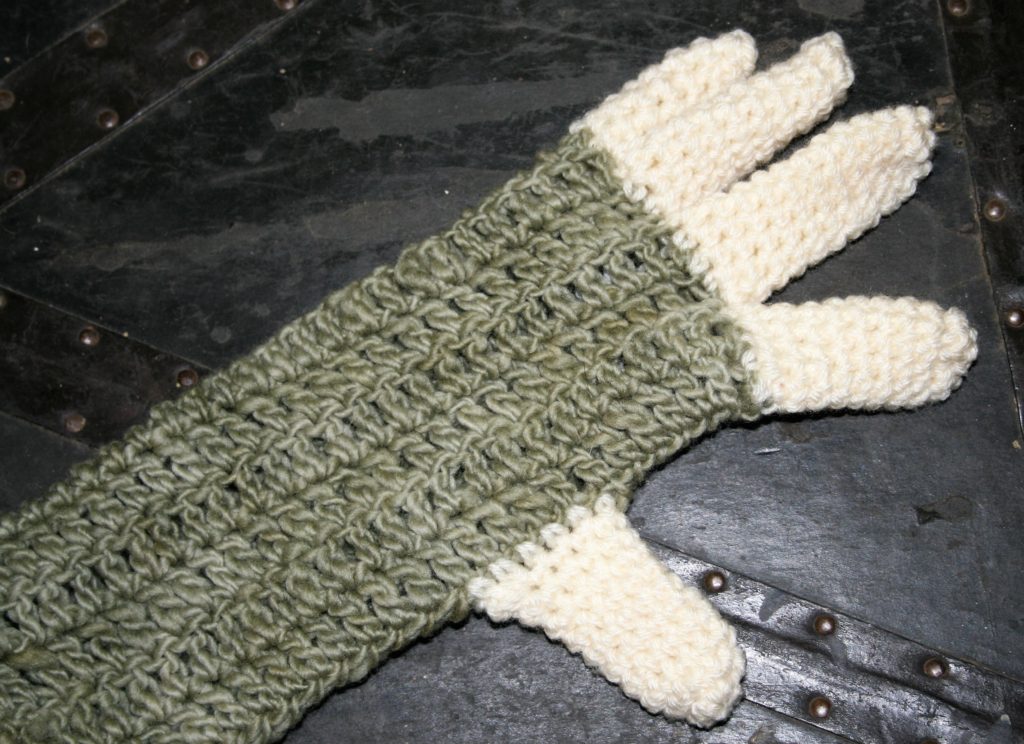
I see a lot of fingerless glove patterns, however not a lot of actual gloves. I have had some people tell me that they think that gloves are just too hard, well to this I disagree.
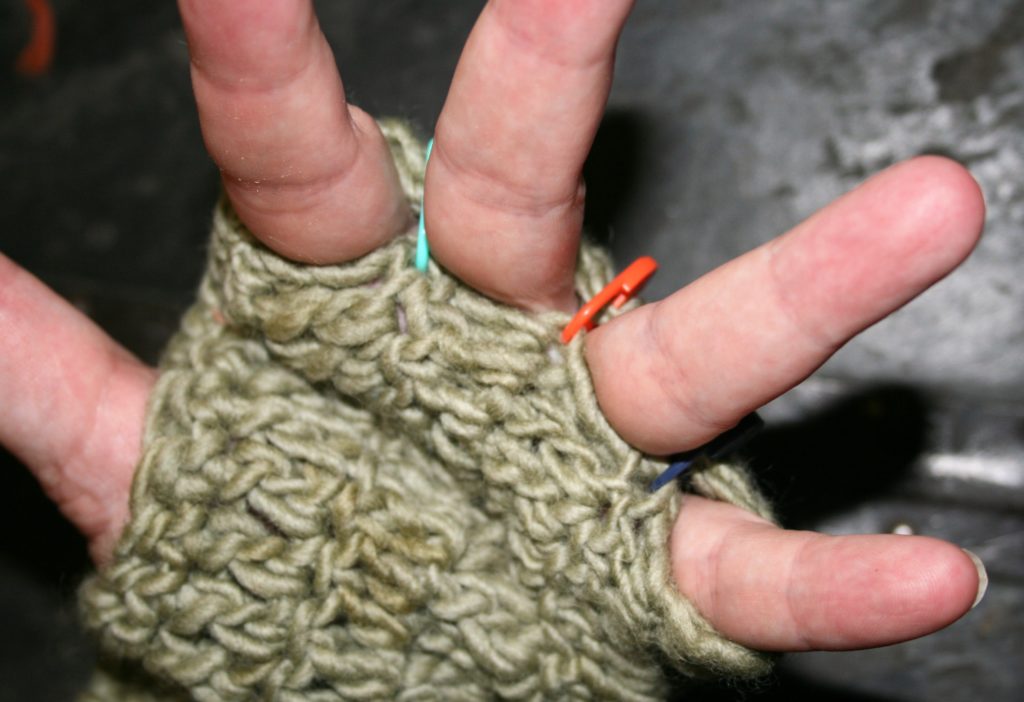
Once you have your fingerless glove made, the next set is to put it one. Take 3 removable stitch markers (or safety pins), insert them between your fingers through both the front and back of the glove fabric.
Insert stitch markers of safety pins between the fingers.
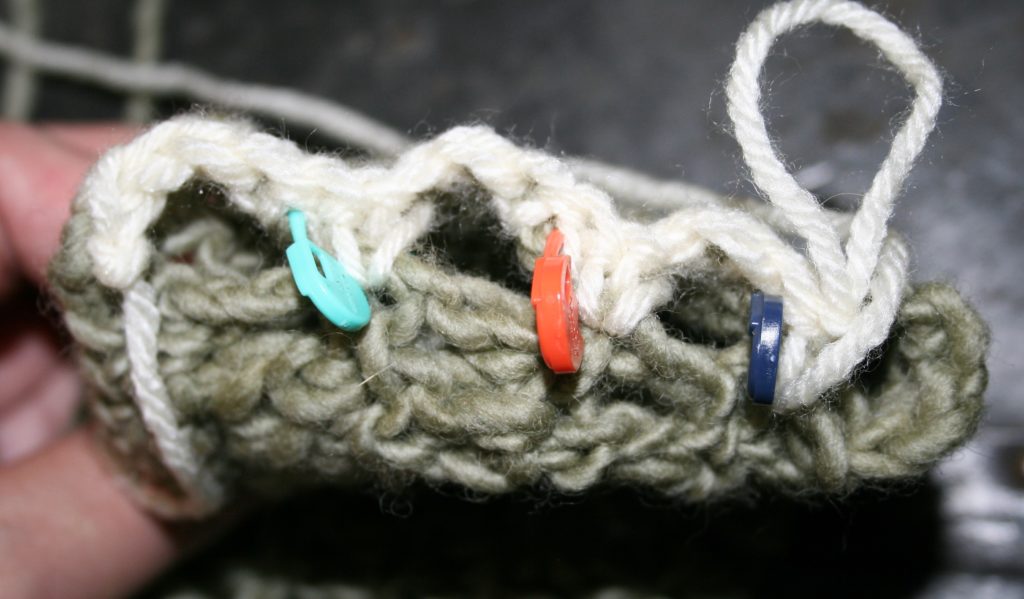
Join yarn anywhere along the finger edge of the fabric. If you were working a pattern that was stitched wrist to fingers, you can simply keep working the yarn from the last round without finishing off.
Start crocheting the “separations”
Work stitches, I recommend single crochet, evenly along edge. Work a slip stitch to the adjacent stitch (the one on the fabric on the other side of the hand) whenever you come to a stitch marker. This will create the “separation” between the fingers. I even just work this technique when I am still just creating fingerless gloves. I feel like it helps them stay in place and not twist around my hand.
When working the single crochets, slip stitch across the fabric on the opposite side of the glove to create the finger “separations”.
Spiral your fingers
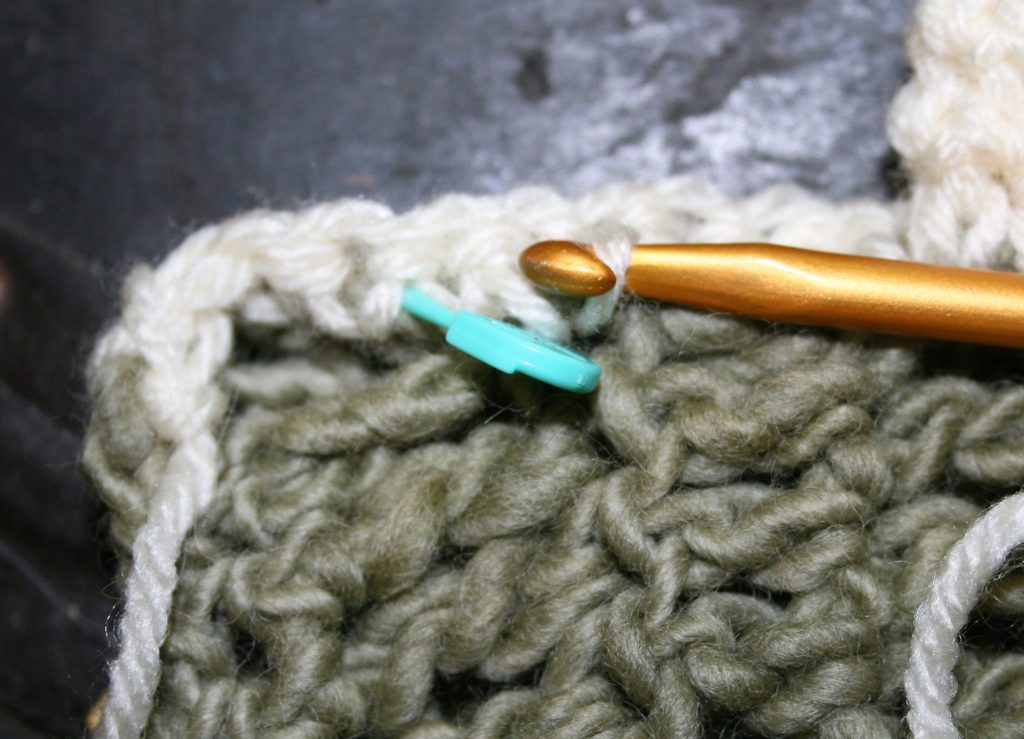
When you begin to work on the opposite side of the hand, and come to a slip stitch, work a single crochet in the one leg of the slip stitch that is closest to the last single crochet worked. Single crochet in a spiral by working on the fabric side previously worked, and work a tube the length of your finger.
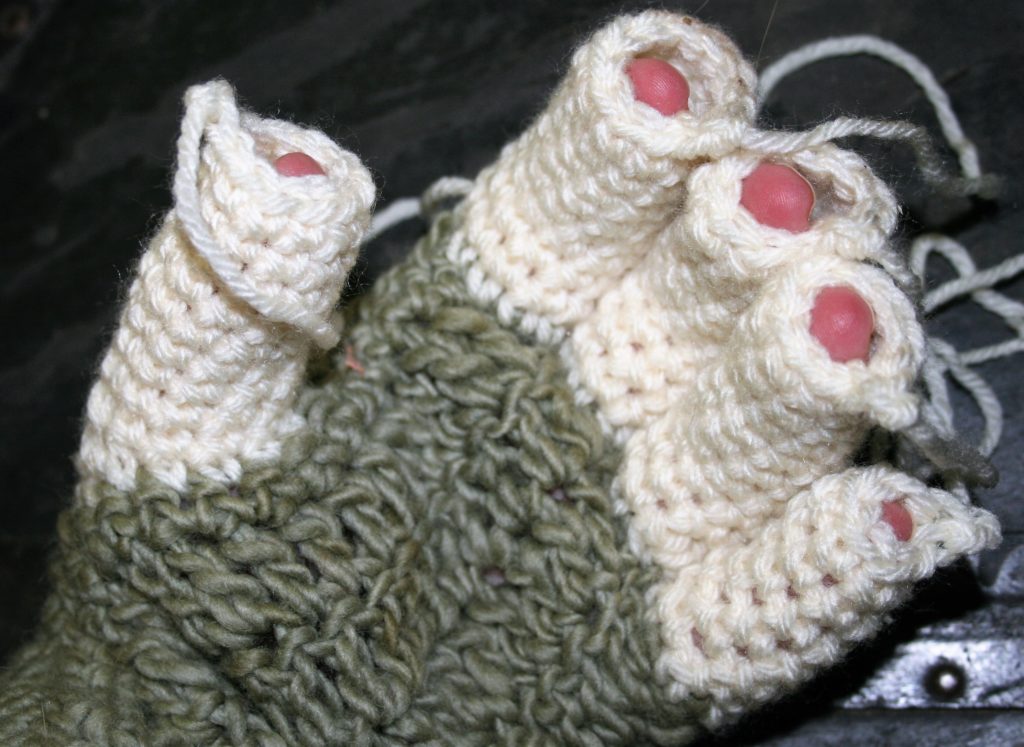
Finish off your yarn, and join to fabric right next to the finger just made. Make the next finger working a stitch in the “one leg” of the slip stitch, of each side of the finger, and continue with the spiral method until the length meets your need. Repeat this of the remaining two fingers.
Work a single crochet in “one leg” of the slip stitch.
Make a thumb
Work the thumb in the same manner, joining to the edge of the thumbing opening and crocheting around it. However this opening may be much larger than the end of your thumb. Work two single crochet together (sc2tog) once in the first and second round. Then continue until the desired length is reached.
Work the spirals until each finger is the desired length.
Cinch them closed
Prepare to weave in the ends. Thread the tails at the ends of the fingers through the stitches in the last round of each finger and pull tight to cinch closed.
Glove
I do recommend that working fingers, it is best to use thinner weight yarn, nothing above a sport weigh (number 3). I usually work most of my gloves, and even fingerless gloves out of wool blended yarns that are either a fine or medium weigh (number 2 or 3). This is because anything heavier just becomes too bulky and feel clumsy on my hands. The nice thing about gloves is that you can complete a pair with only one hank of yarn, and feel really accomplished in your skills.
I think everyone needs a little pick me up in July, so I am releasing my latest free pattern. I hope to brightens the dances of your hook.
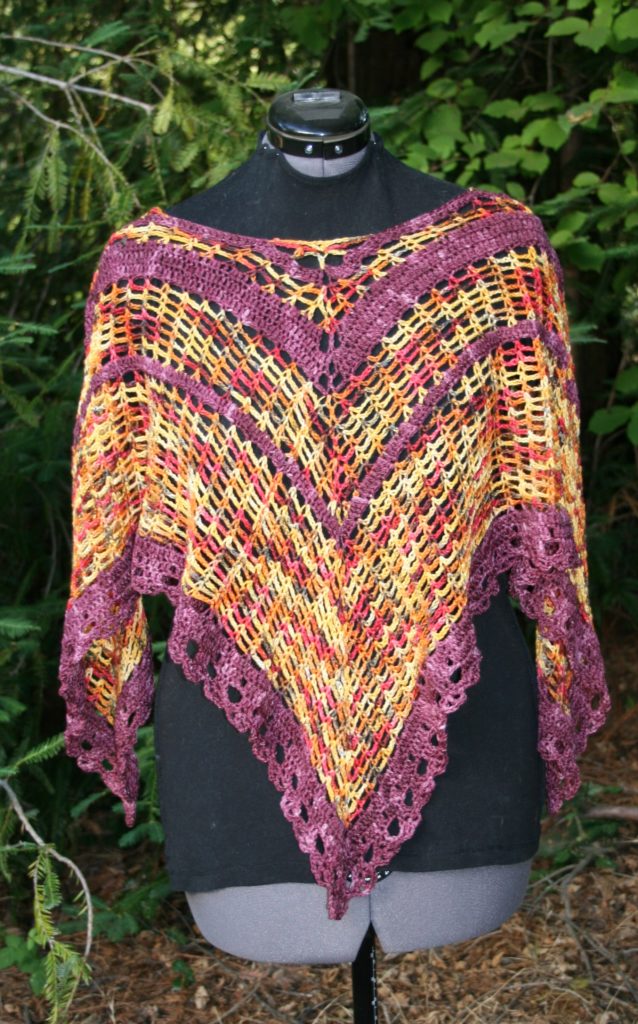
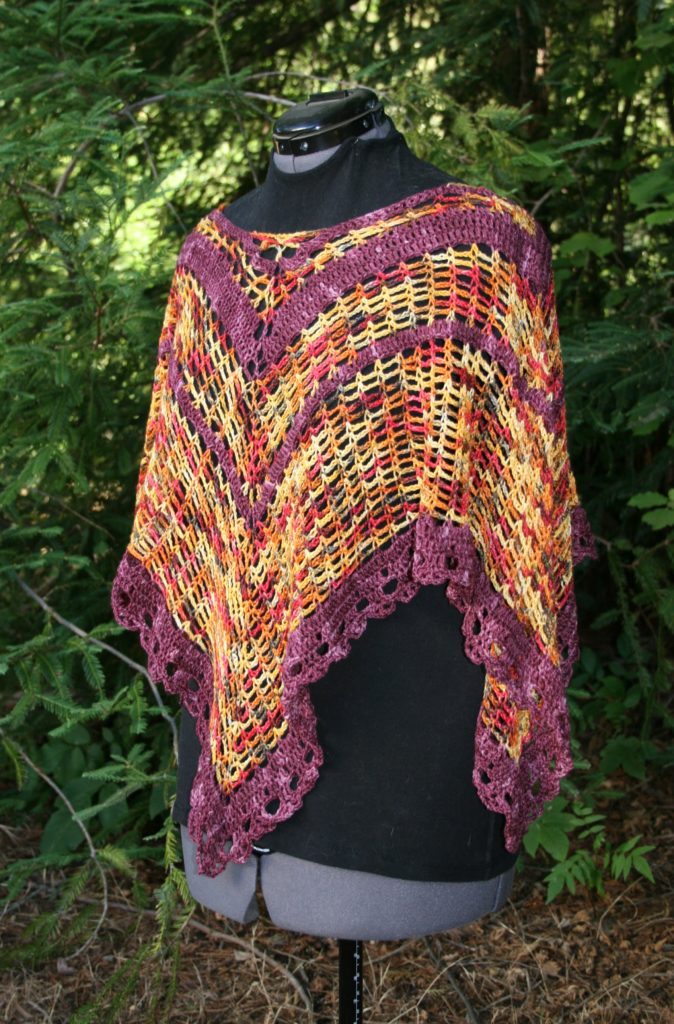
Worked from the neck outward, this is a poncho that easily adds a bit of flare to any wardrobe. The simple stitch pattern lends to great coloring pooling and a fabulous drape.
Phoenix Poncho
Size
40” square
Skill Level
Intermediate
Gauge
5 (sc, ch-3) sts/ 13 rows=4”
Materials
H/8/5.0 mm crochet hook
Alexandra The Art if Yarn Silverton Fine weight 75% Superwash Merino/ 15% Nylon/ 10% Tencel yarn (434yrds/397m/3.5oz/100g) 1 skein each color Wine (A), Fire (B)
Notes
When joining at the end of round 1 ensure that the round is not twisted.
Neck Edging is worked as four separated corner points.
Pattern
Rnd 1: With A, ch 150, dc in 4th ch from hook, dc in next 36 chs, [ch 2 (corner made), dc in next 37 chs] rep 3 times, ch 2, sl st to top of beg ch, (weave tail into base of the beg chain to close ring) change to B. – 148 dc, 4 ch-2 sps
A little bit of an airy stitch…
Rnd 2: Ch 1, sc in same st, {[ch 3, sk 3, sc in next st] rep across to ch-2 corner, ch 1, (sc, ch 3, sc) in ch-2 sp, ch 1, sc in next st,} 3 times, [ch 3, sk 3, sc in next st] rep across to ch-2 corner, ch 1, (sc, ch 3, sc) in ch-2 sp, ch 1, sl st to join. – 40 (ch-3) sps, 8 (ch-1) sps
Rnd 3: Ch 1, sc in same st, {[ch 3, sc in next sc] across to corner, ch 3, dc in ch-3 sp of corner} rep 4 times, ch 3, sc in next sc, ch 3, sl st to join. – 4 dc, 52 (ch-3)sps
Rnd 4: Ch 1, sc in same st, {[ch 3, sc in next sc] across to corner, ch 3, (sc, ch 3, sc) in dc} rep 4 times, ch 3, sc in next sc, ch 3, sl st to join, change to A.
Making it a bit more solid…
Rnd 5: Ch 3, {[3 dc in ch-3 sp, dc in sc] rep across to corner, ch 3, dc in ch-3 corner sp, ch 3, dc in sc} rep 4 times, 3 dc in ch-3 sp, dc in sc, 3 dc in ch-3 sp, sl st to join.
Rnd 6: Ch 3, [dc in each dc across to corner, 3 dc in ch-3 sp, (dc, ch 3, dc) in dc, 3 dc in ch-3 sp] rep 4 times, dc across to first st, sl st to join.
Rnd 7: Ch 3, [dc in each dc across to corner, ch 3, dc in ch-3 sp, ch 3] rep 4 times, dc across to first st, sl st to join, change to B.
Phoenix Poncho
Back to being airy…
Rnd 8: Ch 1, sc in same st, {[ch 3, sk 3, sc in next st] rep across to corner, ch 3, (sc, ch 3, sc) in dc, ch 3, sc in next dc} rep 4 times, [ch 3, sk 3, sc in next st] 3 times, sl st to join.
Rnd 9: Ch 1, sc in same st, {[ch 3, sc in next sc] across to corner, ch 3, dc in ch-3 sp of corner} rep 4 times, ch 3, [sc in next sc, ch 3] across to first st, sl st to join.
Rnd 10: Ch 1, sc in same st, {[ch 3, sc in next sc] across to corner, ch 3, (sc, ch 3, sc) in dc} rep 4 times, ch 3, [sc in next sc, ch 3] rep across to first st, sl st to join.
Rnd 11-14: Rep Rnds 9 & 10.
Rnd 15: Rep Rnd 9, changing to A at join.
A bit of solid…
Rnd 16: Ch 3, {[3 dc in ch-3 sp, dc in sc] rep across to corner, 3 dc in ch-3 sp, (dc, ch 3, dc) in dc} rep 4 times, 3 dc in ch-3 sp, [dc in sc, 3 dc in ch-3 sp] rep across to first st, sl st to join, change to B.
Needs to be airy…
Rnd 17: Rep Rnd 8.
Rnds 18-33: Rep Rnds 9 & 10, change to A at the join of Rnd 33.
Rnd 34: Rep Rnd 9.
Rnd 35: Rep Rnd 16.
Let’s finish it up…
Rnd 36: Sl st in next st, ch 3, dc in next 4 sts, ch 1 sk 1, {[dc in next 5 sts, ch 1, sk 1] rep across to corner, (dc, ch 1, dc, ch 1, dc) in ch- 3 sp, ch 1, sk 1} rep 4 times, [dc in next 5 sts, ch 1, sk 1] across to first st, sl st to join.
Rnd 37: Sl st in next st, ch 3, dc in next 2 sts, {[ch 3, sk dc, sk ch-1 sp, sk dc, dc in next 3 dc] rep across to corner, ch 3, sk dc, sk ch-1 sp, sk dc, dc in next ch-1 sp, ch 1, dc in next dc, ch 1, dc in ch-1 sp} rep 4 times, [ch 3, sk dc, sk ch-1 sp, sk dc, dc in next 3 dc] across to first st, ch 3, sl st to join.
Rnd 38: Sl st in next st, ch 5, (dc, ch 2, dc) in same st, sc in ch-3 sp, sk next dc, {[(dc, ch 2, dc, ch 2, dc) in next dc, sc in ch-3 sp] across to corner, sk next dc (dc, ch 2, dc, ch 2, dc, ch 2, dc, ch 2, dc) in corner dc, sc in ch-3 sp} rep 4 times, [(dc, ch 2, dc, ch 2, dc) in next dc, sc in ch-3 sp] across to first st, sl st to join. Fasten off. Weave in ends.
Neck Edging, Work in each corner
Row 1: From any corner, join with B to stitch 7 away from corner, ch 3 (counts as dc), dc in corner, sk next 6 sts, dc in next st, turn.
Edging: Ch 2 sc in base of dc, ch 3, sk 3 sts of neck, sc in next st, turn, ch 5, dc in center dc of Row 1, ch 1, dc in same st, ch 5, sk 3 sts from join of Row 1, sc in next st, turn, ch 3, sc in join of Row 1, ch 2, sl st to center dc in Row 1. Fasten off. Weave in ends.